Cloister in Los Arcos on the Camino de Santiago

Cloister in Los Arcos on the Camino de Santiago

Monday, May 30, 2011

Day Two - St Jean to Orisson


DAY TWO - 17TH May – Early Morning in St Jean Pied to Port

Day two - Stage one of eight - only 8km through pleasant countryside - but rising over 2,000 ft - it may be less when measured in metres but we were walking with our feet...


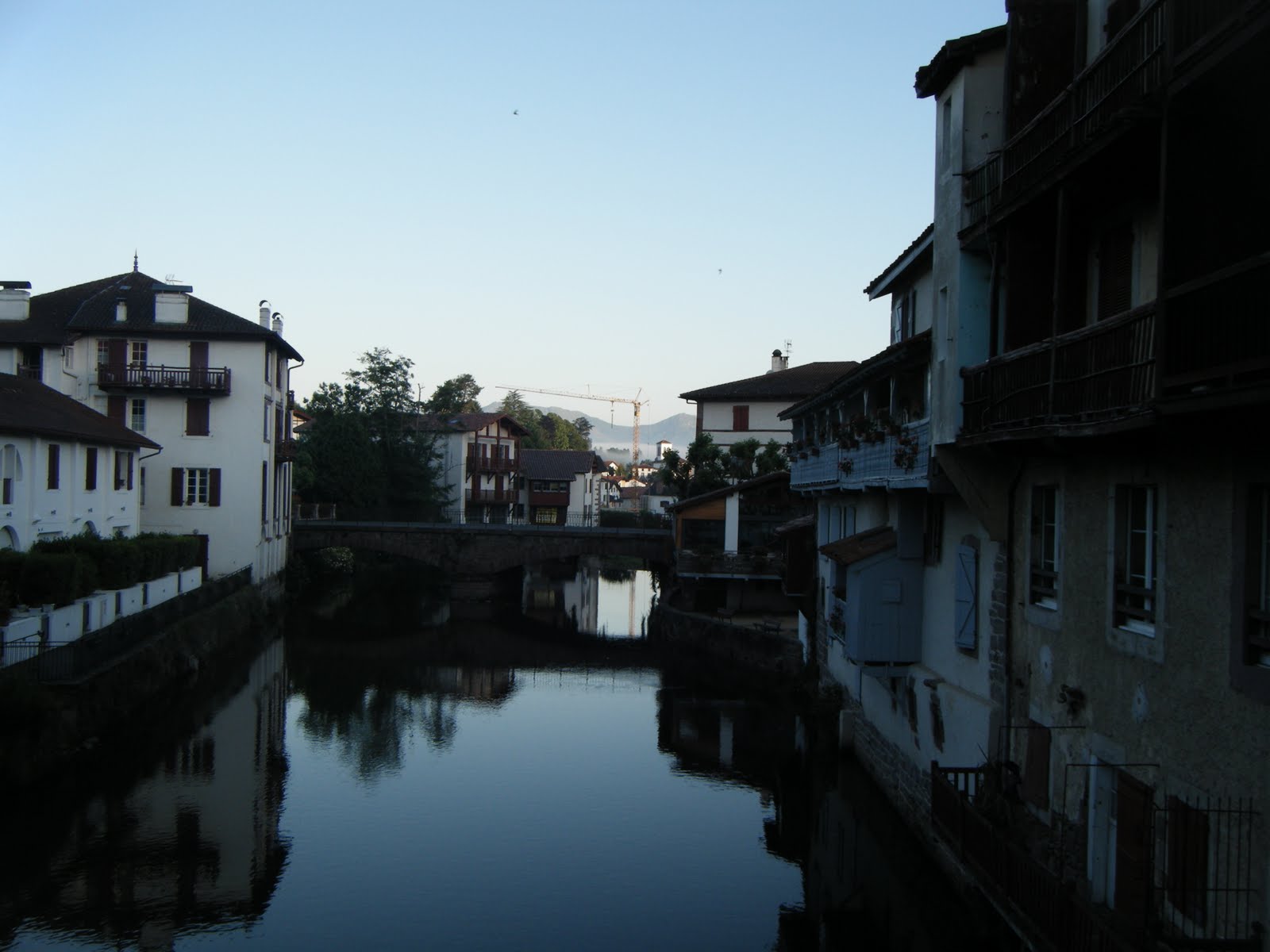
St. Jean Pied de Port in the early morning. The dawn mist slumbers beyond the river Nive.


I rose early – around 6.00 pm and crept out of the hostel. I needn’t have bothered creeping. There were pilgrims already washing, rolling up sleeping bags and packing rucksacks. I walked down the Rue de la Citadelle to find pilgrims already on the march in the early light. St Jean had a magical, almost mystical feel to it. Full of suspense and pious romance.

We had a modest breakfast of coffee au lait and croissants. We left our ruck sacks in the entrance of the hostel at the tender mercies of Jacotrans, the taxi service that would bring our rucksacks ahead every day to our evening destination.


We spent the morning visiting the charming town of St. Jean. People killed time in different ways. Fraser bought a pair of shorts and others bought other essentials – sun cream and toothpaste.


We tried to spread our custom as wide as possible...


We had a simple lunch in a bar across from the Hotel de Ville. People were getting anxious at this stage to be started so we headed off through the Porte D’Espagne and into the foothills of the Pyrenees.


Porte D'Espagne leading out of town and into the Pyrenees, the real start of the Camino Frances. Left at the top of the street and just keep going straight for 800km.


The Murrays arrive at Orisson - eventually!


Sunday, May 29, 2011

Supper under the Citadelle Wall


DAY ONE – March 16th – An army marches on its stomach


Barry, Fraser, P and Pat enjoying the first supper.

Before checking into Gite Ultreïa we popped into the local tourist/camino office. The staff were mostly volunteers and could not be more helpful. I decided to get a new pilgrim passport – or ‘Credencial’. Barry decided that his original Credencial would be more authentic. As a result I tried to get a stamp wherever I could and Barry reserved his passport for only the 'more important' stops.

Armed with our camino paraphernalia we checked into Gite Ultreïa – our hostel – situated conveniently on the main street – Rue de la Citadelle where the staff recommended the restaurant across the street. Afraid of nepotism we wandered the cobbled streets of St Jean to find that indeed the restaurant closest to us was probably the best.
We found a trestle table in the Garden which had the Citadelle as its back wall. The odd tourist walked along the walls and inspected our supper.
I had a decision to make – would I stay ‘dry’ for the 11 days? I decided I would and promptly regretted my decision when the waiter brought out a bottle of the local cider followed by a bottle of the local wine which Barry declared as ‘acceptable’. We met a couple dining in the garden who were finishing their camino in St Jean having walked from Switzerland. As we were to discover, there are many ways to cover the camino.

Camino Curfew


DAY ONE 16th March – ‘Time for bed’ – attributed to Zebedee in the Magic Roundabout.


Barry and Pat supporting P in our five star sleeping quarters

Fortunately the photo is silent on what exactly was happening. It may have been punishment for P for his taking the bunk with the highest headroom notwithstanding he was the shortest by quite a considerable margin..

We reckoned it was the first time Daniel had been in bed with lights out at 10.00 since he was 4. It was a strange experience for all of us. One by one we fell off to a gently snoring sleep. We all claim to have been the last to sleep. So at least 3 of us are wrong.

DAY ONE - In the beginning...


Monday 16th May – DAY ONE – the arrival


The photograph shows Pat, Barry, Daniel and Fraser standing at the Porte St. Jacques in St. Pied de Port. Our Camino ‘moment’ of the day arrived when we landed at Biarritz airport to be told that suspicious luggage found in the airport hall had forced the evacuation of the building. We spent an hour on the plane waiting for news. We felt that Mr. O’Leary would not be happy with this.
Fraser, who had arrived 30 minutes ahead of us, was wearing an emerald green top. With great enterprise he had organised a taxi to bring us to Bayonne which would allow us to take the train we had booked to St. Jean Pied de Port. In the chaos our taxi had disappeared. (Zeeze crazy French taxis, non?!). In any event we found another taxi who agreed to take us the whole way to St Jean. In that manner we arrived in daylight and about two precious hours ahead of the train.
Bad luck had turned into good. Could this be an omen?


Saturday, April 16, 2011

Way to Easter


I attended a unique and engaging book launch two weeks ago. The Spanish Cultural Institute – El Instituto Cervantes – in Dublin hosted the launch of the book “Buen Camino” by father and daughter team, Peter and Natasha Murtagh. Natasha and her father walked three hundred km of the Camino previously before deciding on walking the whole route last summer.

The journey began fittingly enough at Dawn on the last Sunday in July on Croagh Patrick. They had climbed the stony mountain during the night to be able to watch the dawn rise in the East and light up the Reek and the islands in Clew Bay. They made their way down the mountain and over to Knock Airport where they caught the plane to Bordeaux, the TGV to Bayonne and the little puff puff train to St Jean Pied de Port (the one we hope to take).

Then began an epic 800km journey across the north of Spain. Not content with that epic walk they then walked the further 95km to Finisterre. The book launch comprised the reading of extracts from the book by father and daughter. Peter is a managing editor with the Irish Times and so it cam as no surprise that his pieces were well composed. The surprise was the maturity and poise of Natasha, who was only 18 last year and was awaiting her Leaving Cert results. I was delighted that many of the pieces they read dealt with towns known to Barry and myself from our trip in 2006 – Pamplona, Los Arcos, Estella, Puente la Reina. We are looking forward to meeting them again next month.

I had not intended to buy a book. My house is full of books I buy and have never read. I was so impressed by the father/daughter performance that I bought a book and asked Natasha to dedicate to my daughter Lucy. The chances of Lucy and I completing a Camino are slim but hopefully we will get in some good walks together, beginning this summer in Tenerife.

I had never made the connection between Croagh Patrick and the Camino. I climbed Croagh Patrick in 2009 for the first time. The main day to climb the Reek is on the last Sunday in July which is also the feast day of St James, (Santiago), and the major day of celebration in Santiago de Compostela. My birthplace is Murrisk which is at the foot of Croagh Patrick on the Eve of Reek Sunday which might partly explain my fascination with the Camino.

Last Sunday saw some serious preparation for the Camino. A group of us walked the half marathon from Leenaun in Galway to Maam Cross as part of the Connemarathon. I sported a tee shirt with Haven Logos. It might explain why I got some very nice words of encouragement on the walk.

We left Leenaun just after 11.00 – a few minutes late. Our bus first broke down and then took the wrong route – but that is all part of the fun. With an hour head start over the runners, it was about 12.30 before the first runners started catching up and passing us. One of the first to pass us was a slim African runner – he was completing the ultra marathon 40 miles – we had completed about 4 miles at this stage and he had competed 31! The locals were marvelous. There were teams of local people offering us water every few km. I couldn’t quite reconcile the green credentials of running with many participants throwing nearly full bottles of water to the side of the road.

We had heard horror stories of walkers being pushed aside by impatient runners, tales of spitting and peeing all over the place, none of which materialized. 99% of athletes were perfect ladies and gentlemen. 95% of athletes seemed to be enjoying themselves – the other 5% who were dragging tortured bodies along the asphalt should have been doing something else with their time.

I don’t believe I have ever seen so much Lycra before in my life. The runners came in all shapes and sizes. I had no idea God had so many designs for bums, legs, arms and shoulders. Clearly God had a different mould for every one of us.

In preparation for the walk I gave up the booze 29 days ago. I count the days – I can even tell you the hours. I cannot remember last when I went without drink for four weeks – on Monday it will be a full month. To advance the beatification process I have given up eating meat – for 4 days so far. I have been reading some Buddhist writings recently. I am not sure about the morality of eating another of Gods creatures. This fad will not last long however. I can eat just so much of Cadburys chocolate as a substitute. I think the Buddhists have it right in so many ways – if we leave aside the dubious theology.

All paths lead to St. Jean pied de Port. We are having our first formal planning meeting on Monday chez nous when I hope to conjure up some Spanish food and wine for my fellow pilgrims. Providing wine and meat which I will not share myself – is it heroism or bad manners, hypocrisy or sanctity – or just plain mad?

Thursday, March 3, 2011

St. Jean Pied de Port here we come!


Another baby step

The Monkstown Friends listened to my plans for the Camino and many approached me after my brief talk to offer me money and pledges. I was surprised and delighted to receive in the post a very generous sum of money from a Friend who also sent me a lovely encouraging note.
Michael Fitzgerald who produces the excellent blog provided a link to mine, so I will return the gesture and offer a link to his – www.monkstownquakers.blogspot.com.
Biarritz here we come! Courtesy of Ryanair we are due to arrive in the early afternoon of Monday 16th May. Looking at the websites for Biarritz I discover it is beautiful place. I am sorry we will not have the time to enjoy is marvelous beach and the surf for which it is famous. Maybe we will find another time to visit this elegant seaside town once the haunt of the British Royal family during the summer months.
Instead we will take the airport bus (euro 1.20) to the train station in Bayonne, Previously the capital of Aquitaine, the province owned by England for three hundred years from 1150.
I have booked our train tickets (euro 8.80) to St Jean Pied de Port on the 18.00 service that will get us to our destination in 90 minutes. I have great hopes for the train journey. The track seems to snake though lovely countryside, filed and forest as it snakes its way to the terminus at St J P de P.
Disappointment turned to joy in my efforts to find accommodation in St J P de P. The hotels recommended in the guide books were all quoting euro 50 – 60 per night which seemed a bit heavy.
Thanks to Mr. and Mrs. Google I found a marvelous hostel, house, home – Gite Ultreïa – www.ultreia64.fr of Bernard and Fafa – an ancient four storey house in the middle of medieval town, on the cobbled Rue de la Citadelle. The UK Tripadvisor site was ecstatic about this hostel which opened only in the last year and has got rave reviews. We have tow rooms one of four and one of two beds,
The following morning we can make our way to the Pilgrims office and get our Credencial (passport) and to the tourist office to buy scallop shells, staffs, hats and other important objects.
As we have only 8km on day one (admittedly climbing 2,000 feet!) we have the time to explore St J P de P and its ancient houses of pink and grey schist. I am looking forward to viewing the two Gates – Port de Saint Jacques at the French side and the Port d'Espagne as we leave the town on our way up the mountain. The walk along river Nive is recommended. We can pop into the lovely Gothic church as we leave and light a candle for Haiti. For me it will be a time to consider the first query
Are you convinced of the reality of God and do you respond to His Spirit at work within you?
We might even espy the local rugby player Imanol Harinordoquy (not be spelt or even spoken when drunk) the towering back row forward for France.
Then off we go into the wide open spaces of the Pyrenees. John Brierley says that we should be able to get glimpses of the Griffon Vultures (wingspan 2.5m, I am glad I weigh a tidy 85kg) and other birds of prey, the Falcon, the Sparrow Hawk and the Kite. We should come across the wild ponies known as the Chamois and the Manech goats, famous for their cheese. Being May we should see wild flowers including orchids, violas, narcissus and the pale blue irises that will keep us company the whole stretch of the Camino.
By early afternoon we should have reached just over 2,000 feet and have sight of the Auberge d’Orisson which is run by Jean Jacques Etchandy. We are booked in at euro 30 per night which covers Dinner Bed and Breakfast (in stark contrast to some of the prices I encountered in St J P de P!!). There is an outside terrace and hopefully there will be no cloud – or at least we area above the cloud. Have a look at the lovely photos on the website www.refuge-orisson.com.
Sterner stuff lies ahead with the 17km walk to Roncesvalles (21km adjust for height) – but that is literally for another day.
Finally thanks to my friends in De La sale Churchtown for their support and to Michael and Vincent – every penny counts!
Shalom!

Wednesday, March 2, 2011

Did you know?


Some things you may or may not know about the Camino

The scallop shell is the emblem of the walk and it is common for pilgrims to attach the shell to their rucksack. For a number of years after I returned from the Camino, I persisted in wearing the shell when going on treks and walks. It proved a conversation opener and quite often I would come across another who had walked the Camino and so we swapped stories. The scallop shell traces its roots right back to the death of St James. His body was placed in an unmanned boat which made its way providentially to Santiago. When it arrived it was unblemished and covered in shells. In olden times (and perhaps in modern times too) the shell was used to collect drinking water from the numerous fountains on the route or used as a makeshift plate at mealtime.

The shell is variously deemed to symbolize the various routes which lead to Santiago, or the provenance of the pilgrims who come from many countries. It is also taken to represent the setting sun at Finisterre, just beyond Santiago, which was regarded as the most westerly point of mainland Europe (that honour acutally goes to a place in Portugal). The way markers along the journey invariably bear the sign of the scallop.

The Spanish word for pilgrim is ‘Peregrino’ and the word was first used in relation to people who made their way to Santiago de Compostela. Travelers to other major Christian centers were called Romeros in the case of those travelling to Rome and Palmeros (from the word palm) for those travelling to Jerusalem.

Goethe suggests that the Camino gave rise to the first concept of Europe. ’Europe was built on the pilgrimage to Compostela’ he claimed. In a very divided and insular middle age, the Camino attracted hundreds of thousands of pilgrims every year. Some commentators gave out about the numbers on the roads – it was like Grafton St on Christmas Eve.

The Camino traces its origins back to 813 when a priest in remote Galicia believed he saw a star shine over what today is Santiago de Compostela. The local bishop ordered excavations and claimed to find the body of the apostle James who had been killed by Herod Agrippa in 42 AD. The tomb became a place of worship and a unifying sign for the dispersed Spanish forces who were resisting the Muslim expansion into the very north of Spain. The Spaniards gained an important victory in 844 at the battle of Clavijo when against greater numbers the Spaniards gained an important and decisive victory. Just as the Spaniards were failing, a mysterious figure on horseback entered the fray. It was believed to be none other than Saint James who was given the title ‘Matamoros’ or ‘slayer of Muslims’.

The very first tourist guide in the world was the Codex Calixtinus – ‘A guide for the medieval pilgrim’ which was written in 1139 by Aymeric Picaud a French clergyman. The Codex comprises five books which go into great detail explaining the route, the terrain, the towns, the local people and customs, the dangers, food and countryside.

The eleventh and twelfth centuries saw the Camino grow in popularity. The Benedictines from the great monastery of Cluny lent a hand as did the ‘Catholic Kings’ of Spain who saw the political as well as the spiritual value in the Camino.

The Camino had another side – the thieves and robbers, tricksters and prostitutes who tried to make a living from the pilgrims. Some of the pilgrims themselves became the equivalent of hippies leading lazy lives of wandering and vagabondage.

The Camino declined over the next centuries and found its nadir in 1867 when less than 40 pilgrims arrived on the feast of St. James.

In 1982 Pope John Paul II gave the Camino a shot in the arm when he became the first Pope ever to visit the site. Still in 1985 only 3,000 pilgrims applied for the Credencial, in 1993 the number grew to 100,000, in 1999 the number was 154,000 and in 2010 another Holy Year (when the feast of St. James falls on a Sunday) the figure was well in excess of 200,000.

‘Time for bed’ said Zebedee in the Magic Roundabout. How right. Goodnight!